Within Stage changes
How pair work changes ENHYPEN's stage picture
Six members make duos, mirrored pairs, and canon-style ripples more important to how ENHYPEN stages read.
On this page
- Why even numbered formations favour duos
- Which member pairings create clear visual contrast
- How ripples and mirrored moves replace old centre shapes
Page outline Jump by section
Introduction
ENHYPEN’s six-member choreography changes the stage picture by making pair work more important. Without a seventh member to sit naturally in the middle, formations cannot rely as easily on one fixed centre framed by three members on each side. Duos, mirrored pairs and ripple timing become the cleanest way to keep the group looking full, intentional and sharp. That matters because BELIFT LAB has confirmed ENHYPEN will continue as six members after Heeseung’s departure, with Jay, Jake, Sunghoon, Sunoo, Jungwon and Ni-ki carrying the group’s performances forward.[Weverse]weverse.ioWeverse[NOTICE] ENHYPEN's Future ActivitiesAs such, HEESEUNG will be parting ways with ENHYPEN, and ENHYPEN will continue official activi…
 Pair formations do not simply “fill a gap”. They change the grammar of the stage. A six-person ENHYPEN formation is often strongest when the viewer can read three connected duos, two mirrored trios, or a chain of movement passing from pair to pair. For fans, that means watching less for one permanent centre and more for how members answer, reflect or cut across each other.
Why six members make duos feel natural
Odd-numbered groups have an easy visual advantage: one person can stand at the centre while the rest balance around them. Six members do not have that same built-in focal point. Choreographers can still create a temporary centre by pushing one member forward, but the underlying shape is always split: three and three, two and two and two, or one pair framed by two outer pairs.
That makes duos a practical solution. A pair can hold the centre without pretending there is a single middle body. Two members can stand close, overlap depth, or face opposite directions, creating a shared focal point rather than a solo one. General choreography language already treats mirroring, unison, canon and shadowing as standard tools for organising multiple dancers; in a six-member idol group, those tools become especially useful because they turn even-numbered symmetry into a feature rather than a problem.[Wikipedia]WikipediaOpen source on wikipedia.org.
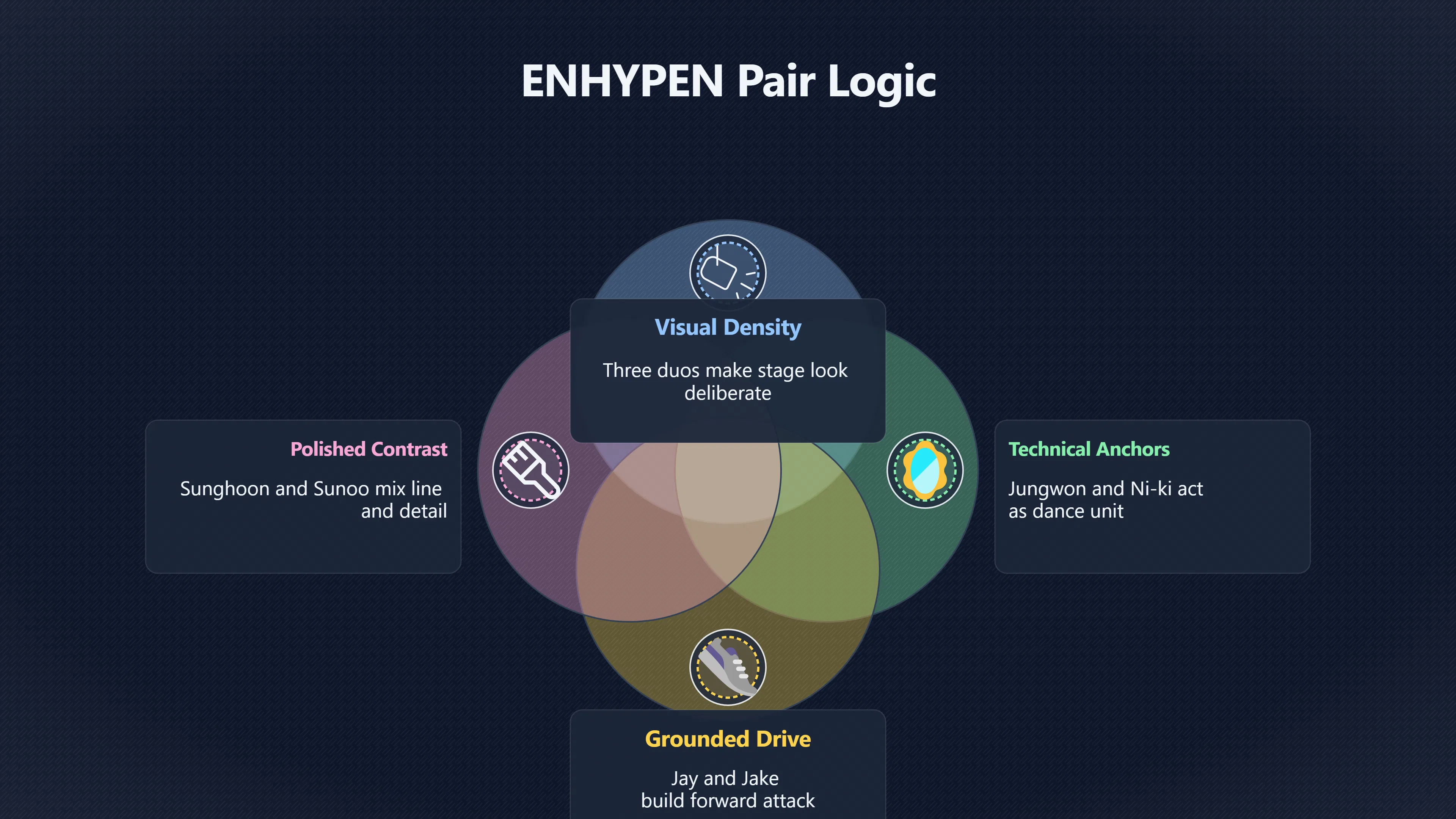
For ENHYPEN, the payoff is visual density. Six bodies spread evenly across a large stage can look exposed, especially in choreography originally associated with a seven-member identity. But three duos can make the same stage look more deliberate. The audience reads structure immediately: left pair, centre pair, right pair; front pair, middle pair, back pair; mirrored pair, shadow pair, counter-pair.
This is why pair work can make six-member choreography feel tighter rather than smaller. The group loses one body, but gains a clearer need for visible relationships between the remaining bodies.
Which pairings create clear visual contrast
The most useful ENHYPEN pairs are not always the ones that look identical. In performance terms, contrast can be more interesting than sameness. A strong duo often works because the members share timing while differing in texture: one sharper, one smoother; one compact, one expansive; one emotionally bright, one cooler or more restrained.
Jungwon and Ni-ki are the clearest reference point because their dance partnership has already been foregrounded outside full-group choreography. Studio Choom’s “Mix & Max” series launched with Jungwon and Ni-ki as its first pair performance, and Ni-ki later told Weverse Magazine that dancing as two rather than seven carried pressure because they had to perform with full energy from start to finish.[Wikipedia]WikipediaStudio ChoomStudio Choom
That comment is useful for understanding six-member ENHYPEN as a whole. Pair work exposes dancers. In a seven-member formation, a member can disappear briefly into a larger picture. In a duo, there is nowhere to hide: timing, weight, arm lines and facial focus all become easier to compare.
Different pairings can therefore serve different stage functions:
- Jungwon and Ni-ki can act as technical anchors, because their pairing already carries a dance-unit identity.
- Jay and Jake can help build grounded, forward-driving pairs, especially where the choreography needs attack rather than delicate symmetry.
- Sunghoon and Sunoo can create a useful contrast between polished line and expressive detail, giving mirrored staging more character.
- Rotating pairs prevent the six-member structure from becoming too predictable, because the audience keeps seeing new relationships rather than one fixed duo system.
The key is not to assign permanent “best pairs”. It is to use pairing as a choreographic switchboard. A chorus may need mirrored stability; a bridge may need emotional contrast; a dance break may need the two strongest movement accents placed opposite each other.
How ripples replace old centre shapes
A ripple, or canon, happens when dancers perform related movement one after another rather than all at once. Dance education sources often describe canon as movement overlapping in time, like one dancer beginning and another following moments later.[creativesteps.co]creativesteps.coDance GlossaryCreative StepsCanon: when movements overlap in time, usually one dancer starts the sequence and another dancer starts a few seconds later…
In six-member ENHYPEN choreography, this matters because ripples can replace the old “centre explosion” effect. A seven-member formation can place one member in the middle, then open around them. A six-member formation often looks cleaner when energy travels across the group instead: one pair starts, another pair answers, the final pair completes the phrase.
That creates motion without needing a fixed middle. The stage picture becomes more like a wave than a portrait.
This suits ENHYPEN’s darker, high-tension performance style. Their official “Bite Me” materials are a useful example of how pair logic can reshape the group’s image: the song’s visual world leaned heavily on partner choreography and doubled bodies, and its dance practice and tour versions became major reference points for fans discussing how pair-based staging changes the song’s effect.[Weverse]magazine.weverse.ioOpen source on weverse.io.[Weverse]weverse.ioENHYPEN (엔하이픈) 'Bite Me' Dance PracticeENHYPEN (엔하이픈) 'Bite Me' Dance Practice
The six-member version of that logic does not need outside partners to work. The same principle can be internalised: members become reflections, shadows or opposing forces for each other.
Why mirrored moves raise the difficulty
Mirrored choreography looks clean when it works, but it is unforgiving. If two members are meant to hit the same angle on opposite sides, a small mismatch becomes obvious. If three pairs are meant to ripple in order, one late transition can make the whole phrase look uneven.
That is why six-member pair work increases the importance of spacing. Recent research into choreography planning notes that formation work depends on dancer positions, orientations, trajectories and movement distances; those are exactly the details fans notice when a dance practice looks unusually satisfying or slightly off.[arXiv]arxiv.orgarXiv Choreo Vis: Planning and Assessing Formations in Dance ChoreographiesarXiv Choreo Vis: Planning and Assessing Formations in Dance Choreographies
For ENHYPEN, this raises the stakes of synchronisation. Their performances have long been judged by clean group execution, but six-member formations make that cleanliness more structural. Pair work does not just decorate the choreography; it holds the frame together.
The tradeoff is clear. Six members can look more exposed, but they can also look faster and more precise. When the pair system is well designed, the absence of a single centre becomes less important because the whole stage keeps generating new focal points.

The new stage picture fans should watch for
The most interesting six-member ENHYPEN formations are likely to be the ones that stop chasing a lost seven-member shape. Pair work gives the group another route: three duos that merge, split, mirror, ripple and trade focus.
That changes what fans should look for in performances. Instead of asking only who gets the centre, it becomes worth watching who is paired with whom, which duo initiates the movement, whether the outer pairs mirror the middle, and how quickly focus travels across the line.
In that sense, pair formations are not a compromise. They are the mechanism that can make six-member ENHYPEN read as a redesigned performance unit rather than a reduced one.
Amazon book picks
Further Reading
Books and field guides related to How pair work changes ENHYPEN's stage picture. Use these as the next step if you want deeper reading beyond the article.
Shine
Covers the pressure of image, teamwork and performance identity inside idol systems.
K-Pop: The Ultimate Fan Book
Helpful broader context for readers following ENHYPEN’s evolving stage dynamics.
Idols and Celebrity in Japanese Media Culture
Provides context for performer roles and stage dynamics.
eBay marketplace picks
Marketplace Samples
Example marketplace items related to this page. Use the search link to explore similar finds on eBay.




Endnotes
1.
Source: weverse.io
Link:https://weverse.io/enhypen/notice/34159
Source snippet
Weverse[NOTICE] ENHYPEN's Future ActivitiesAs such, HEESEUNG will be parting ways with ENHYPEN, and ENHYPEN will continue official activi...
2.
Source: Wikipedia
Link:https://en.wikipedia.org/wiki/Choreography
3.
Source: creativesteps.co
Title: Dance Glossary
Link:https://creativesteps.co/dance-glossary/
Source snippet
Creative StepsCanon: when movements overlap in time, usually one dancer starts the sequence and another dancer starts a few seconds later...
4.
Source: Wikipedia
Title: Studio Choom
Link:https://en.wikipedia.org/wiki/Studio_Choom
5.
Source: magazine.weverse.io
Link:https://magazine.weverse.io/article/view?lang=en&num=467&ref=
6.
Source: weverse.io
Title: ENHYPEN (엔하이픈) ‘Bite Me’ Dance Practice
Link:https://weverse.io/enhypen/media/0-119786350?hl=es
7.
Source: weverse.io
Link:https://weverse.io/enhypen/media/3-125947302
8.
Source: Wikipedia
Title: Bite Me (Enhypen song)
Link:https://en.wikipedia.org/wiki/Bite_Me_%28Enhypen_song%29
9.
Source: arxiv.org
Title: arXiv Choreo Vis: Planning and Assessing Formations in Dance Choreographies
Link:https://arxiv.org/abs/2404.04100
10.
Source: weverse.io
Link:https://weverse.io/enhypen/notice/34925
11.
Source: weverse.io
Link:https://weverse.io/enhypen/media/0-105451735
12.
Source: weverse.io
Link:https://weverse.io/enhypen/notice/26311
13.
Source: weverse.io
Link:https://weverse.io/enhypen/media/0-119786350
14.
Source: magazine.weverse.io
Link:https://magazine.weverse.io/article/view/740?artist=ENHYPEN&lang=e
15.
Source: magazine.weverse.io
Link:https://magazine.weverse.io/article/view/1269?artist=ENHYPEN&lang=ko%3Cbr%3E%EB%8F%84%EC%9B%80%EB%90%A0%EC%A7%80
16.
Source: weverse.io
Title: [EPISODE] ‘Bite Me’ MV Shoot Sketch
Link:https://weverse.io/enhypen/media/0-119518576
17.
Source: weverse.io
Link:https://weverse.io/enhypen/media/0-145137672
18.
Source: magazine.weverse.io
Link:https://magazine.weverse.io/article/view/1271?artist=ENHYPEN&lang=es
19.
Source: weverse.io
Title: ENHYPEN Media
Link:https://weverse.io/enhypen/media/2-119485731
20.
Source: weverse.io
Link:https://weverse.io/enhypen/media/0-2473477
21.
Source: weverse.io
Title: ENHYPE N Media
Link:https://weverse.io/enhypen/media/4-106794826
22.
Source: weverse.io
Link:https://weverse.io/enhypen/media/2-8844615
23.
Source: instagram.com
Link:https://www.instagram.com/reel/C3AGcPWyxGm/
24.
Source: instagram.com
Link:https://www.instagram.com/reel/CyRI7hdMPid/?hl=en-gb
25.
Source: facebook.com
Link:https://www.facebook.com/groups/3573265256258374/posts/4218764888375071/
26.
Source: aqa.org.uk
Link:https://www.aqa.org.uk/subjects/dance/gcse/dance-8236/specification/subject-content/choreography
Additional References
27.
Source: en.yna.co.kr
Link:https://en.yna.co.kr/view/AEN20260310008800315
28.
Source: youtube.com
Title: ENHYPEN (엔하이픈) ‘Bad Desire (With or Without You)’ Dance Practice
Link:http://www.youtube.com/watch?v=qhgYrr_3zhE
Source snippet
ENHYPEN(엔하이픈) 'Bad Desire (With or Without You)' (4K) | STUDIO CHOOM ORIGINAL...
29.
Source: youtube.com
Title: ENHYPEN (엔하이픈) ‘No Doubt’ Dance Practice
Link:http://www.youtube.com/watch?v=AkioZY59-DA
Source snippet
ENHYPEN dance practice choreography pair formation ENHYPEN (엔하이픈) 'Outside' Dance Practice ENHYPEN...
30.
Source: researchgate.net
Link:https://www.researchgate.net/publication/381323807_ChoreoVis_Planning_and_Assessing_Formations_in_Dance_Choreographies
31.
Source: blended-learning.resources.wjec.co.uk
Link:https://blended-learning.resources.wjec.co.uk/en/mfw25-26_28-6/2/7
32.
Source: soompi.com
Link:https://www.soompi.com/article/1824084wpp/breaking-enhypen-announces-heeseungs-departure-from-group
33.
Source: dhcn.cn
Link:https://www.dhcn.cn/columns/14254.html
34.
Source: x.com
Link:https://x.com/PRODBYENGENE/status/1516783074289524737
35.
Source: reddit.com
Link:https://www.reddit.com/r/unpopularkpopopinions/comments/15fvv73/enhypens_bite_me_choreography_looks_better_with/
36.
Source: reddit.com
Link:https://www.reddit.com/r/kpopthoughts/comments/1qxqvy4/even_vs_odd_whats_better_for_kpop_groups_and/
Topic Tree